The End of the Referral Economy
We have transitioned from an era of Search to an era of Synthesis. The digital ecosystem is currently undergoing its most profound structural transformation since the advent of the commercial internet. If you have felt that the "old rules" of the web — write content, rank high, get traffic — are breaking, you are not imagining it.
In February 2024, Gartner released a prediction that was met with skepticism: they forecasted that search engine volume would decline by 25% by 2026 due to AI chatbots. As of early 2026, the data suggests this was conservative.
From "Search" to "Prompt"
To understand the current economy, we must look at "cognitive load." Traditional search forced the user to do the work: type a query, scan ten blue links, open three tabs, read, and synthesize an answer.
Generative AI (GenAI) offloads that burden to the machine. As Gartner analyst Alan Antin noted, "People often google things that are a poor fit for a ranked list of websites. They just need an answer."
By 2026, the integration of LLMs into Google (AI Overviews) and the rise of Perplexity and SearchGPT have turned "searches" into "prompts."
The "Zero-Click" Baseline
For years, publishers feared the "Zero-Click" search. In 2025, it became the standard.
- 60% of all Google searches are now zero-click.
- 77% of mobile searches end without a referral.
This is most prevalent in "informational" queries (history, coding, recipes). The search engine is no longer a roadmap; it is the destination. The "referral economy" has been replaced by an "extraction economy," where platforms use your content to generate answers while keeping the user inside their walled garden.
The Traffic Cliff
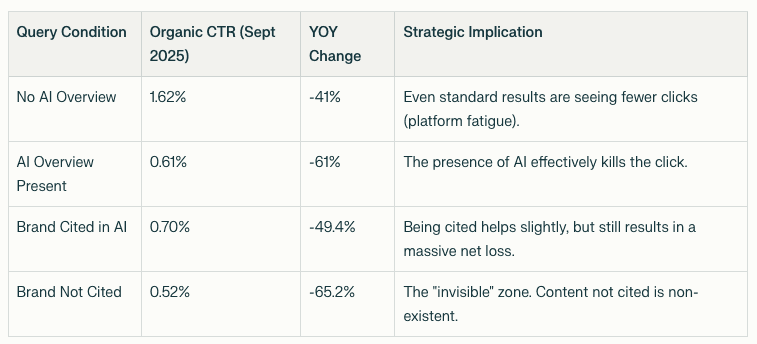
The most definitive data on this crash comes from Seer Interactive's longitudinal study (2024-2025). They found that the presence of an AI Overview (AIO) is catastrophic for click-through rates (CTR).
The data shows a 61% drop in organic CTR when AI Overviews appear. This indicates that when a machine answers, users stop scrolling. The "ten blue links" below the AI summary are rendered invisible.
The Citation Paradox
AI companies argued that they would act as "super-aggregators," citing sources and driving traffic. The data proves this is a fallacy.
A study by Pew Research Center (July 2025) identified the "Citation Paradox":
- The 1% Reality: Users click on citation links in AI summaries only 1% of the time.
- Verification Theater: Users glance at citations merely to trust that the AI isn't hallucinating. They treat the citation as a "trust badge," not a navigation link.
Users are also 26% more likely to end their browsing session immediately after reading an AI summary. The AI resolves the query to a level of satisfaction that precludes further effort. The "journey" ends at the search bar.
The Algorithmic Aristocracy
In this new ecosystem, not all sources are equal. AI models demonstrate a massive bias toward structured, consensus-driven data, creating a "Winner-Take-Most" dynamic.
- Wikipedia: The "Spine of Knowledge," accounting for over 11% of citations.
- Reddit: The "Voice of Human Experience." Traffic grew to 1.4 billion visits as users fled AI spam for authentic human answers.
- LinkedIn: The "Verifier of Expertise," used to establish author authority.
Conversely, independent publishers are losing visibility. The top 20 domains now account for over 66% of all citations.
References
- Gartner, Feb 2024 Forecast
- Alan Antin, VP Analyst at Gartner
- The Digital Bloom & SparkToro, 2025 Analysis
- Seer Interactive Longitudinal Study, Sept 2025
- Pew Research Center, "The Citation Paradox," July 2025
- Analysis of AI Overview Citations, 2025
Originally published on the Aurora Intelligence Substack.