Why Single AI Visibility Measurements Are Misleading
A new paper — "Don't Measure Once: Measuring Visibility in AI Search (GEO)" — shows that measuring a brand's AI visibility requires a fundamentally different approach than tracking traditional search rankings.
The study, co-authored by Julius Schulte, Malte Bleeker, and Philipp Kaufmann, examines how AI visibility varies across repeated searches, different prompts, industries, and AI search platforms like Google AI Mode and Perplexity.
Read the full paper on arXiv →
The Core Problem: AI Search Is Probabilistic
Unlike traditional search engines, which return deterministic ranked lists, AI search engines generate outputs probabilistically. Ask the same question twice and you may get different answers, different brand mentions, and different citations. This variability has major implications for how visibility should be measured.
A single snapshot of AI visibility can be highly misleading. A brand might appear in 60% of AI search results on average, but any individual query might show 0% or 100% — neither giving you the true picture.
Key Findings and Recommendations
1. Run Each Prompt ~7 Times Per Day
The study recommends running each prompt at least 7 times per day to obtain a statistically robust estimate of AI visibility. This accounts for the inherent randomness (temperature) in LLM outputs and ensures you're measuring a stable probability rather than a lucky or unlucky single draw.
2. Measure Continuously — Minimum 2–4 Weeks
Short measurement windows are too noisy. You need at minimum 2–4 weeks of continuous measurement (ideally ongoing) to detect meaningful trends. LLM algorithms change frequently, and short snapshots can confuse algorithmic shifts with organic visibility changes.
3. Use a Broad Prompt Portfolio
One or two prompts are not enough to reflect a brand's overall AI visibility. Different phrasings of the same question can produce dramatically different results. A broad, representative set of prompts is needed to accurately assess visibility across the range of queries your target audience actually uses.
4. Set Platform-Specific Benchmarks
AI visibility differs significantly across platforms. A brand that ranks prominently in Perplexity results may be nearly invisible in Google AI Mode — and vice versa. Platform-specific benchmarks are essential because the underlying models, retrieval mechanisms, and citation behaviours differ substantially between platforms.
5. Focus on High-Citation Sources
AI citations are highly concentrated in a relatively small number of domains. A handful of sources dominate AI citations across most industries. The strategic implication is clear: identify which sources are cited most often in your niche and focus your PR and content efforts on getting included there.
A New Mental Model for AI Visibility
The practical takeaway is a paradigm shift: AI visibility must be managed as a probability over repeated measurements, not as a one-time ranking snapshot.
Treating AI visibility like a traditional rank (you're either #1 or you're not) misses the probabilistic nature of how AI systems work. The better mental model is share-of-voice — what percentage of AI responses in your category mention your brand?
| Traditional SEO | AI Visibility (GEO) |
|---|---|
| Fixed ranking | Probability across responses |
| Single measurement sufficient | Repeated measurements required |
| One search engine | Multiple AI platforms |
| Keyword rank | Share of citations |
How Aurora Intelligence Applies These Insights
Aurora Intelligence is built around exactly these principles. The platform:
- Runs each prompt multiple times per measurement cycle to produce statistically reliable visibility scores
- Tracks continuously so you can see trends over weeks and months, not just point-in-time snapshots
- Covers multiple platforms including Perplexity, Google AI Overviews, ChatGPT, and more
- Monitors citation sources to show you which domains AI engines are citing in your category
The research validates what we see in practice: reliable AI visibility measurement requires fundamentally different infrastructure than traditional rank tracking.
Read the Full Paper
"Don't Measure Once: Measuring Visibility in AI Search (GEO)" by Julius Schulte, Malte Bleeker, and Philipp Kaufmann is available open-access on arXiv.
Discuss on LinkedInKey Figures from the Paper
Figure 1 — Day-to-day source stability
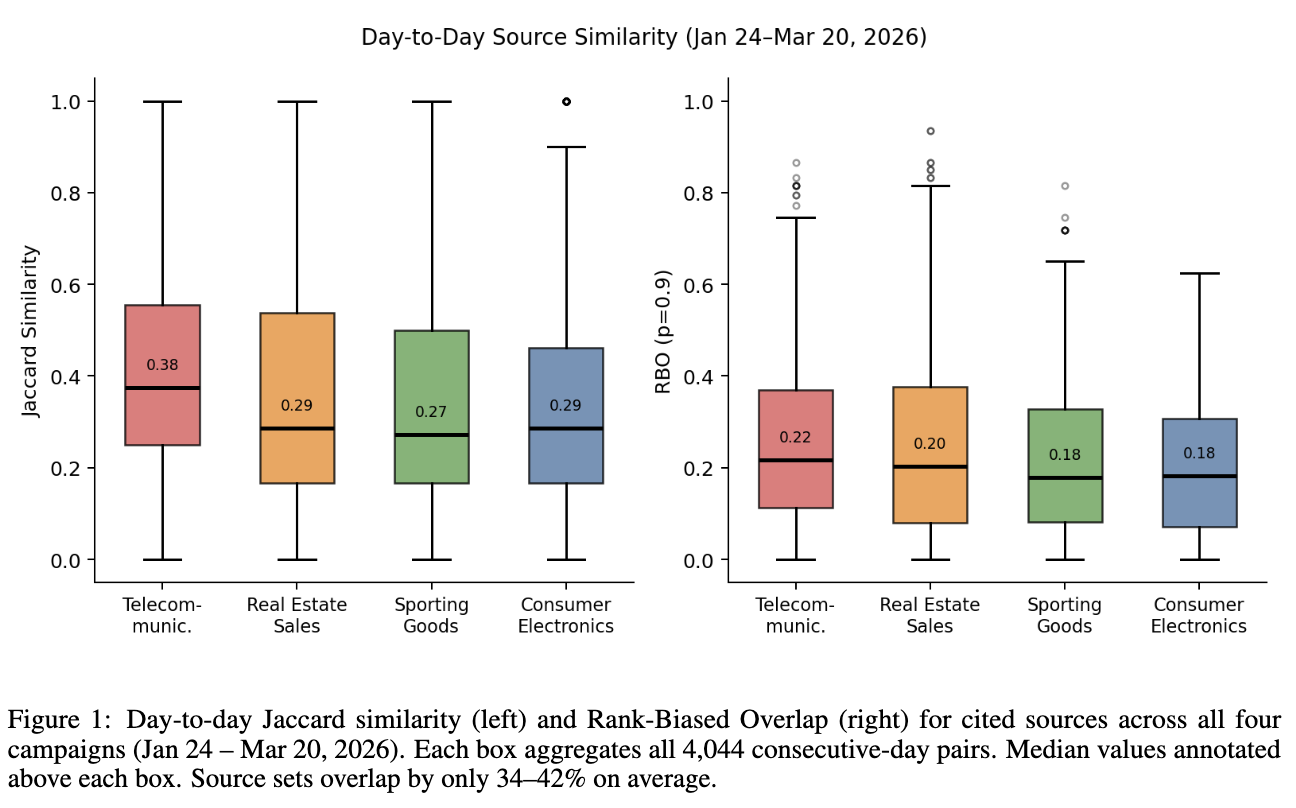
Jaccard similarity and Rank-Biased Overlap for cited sources across four campaigns (Jan 24 – Mar 20, 2026). Source sets overlap by only 34–42% on average from one day to the next — confirming that a single measurement captures a highly variable snapshot, not a stable truth.
Figure 2 — Brand stability vs. source stability
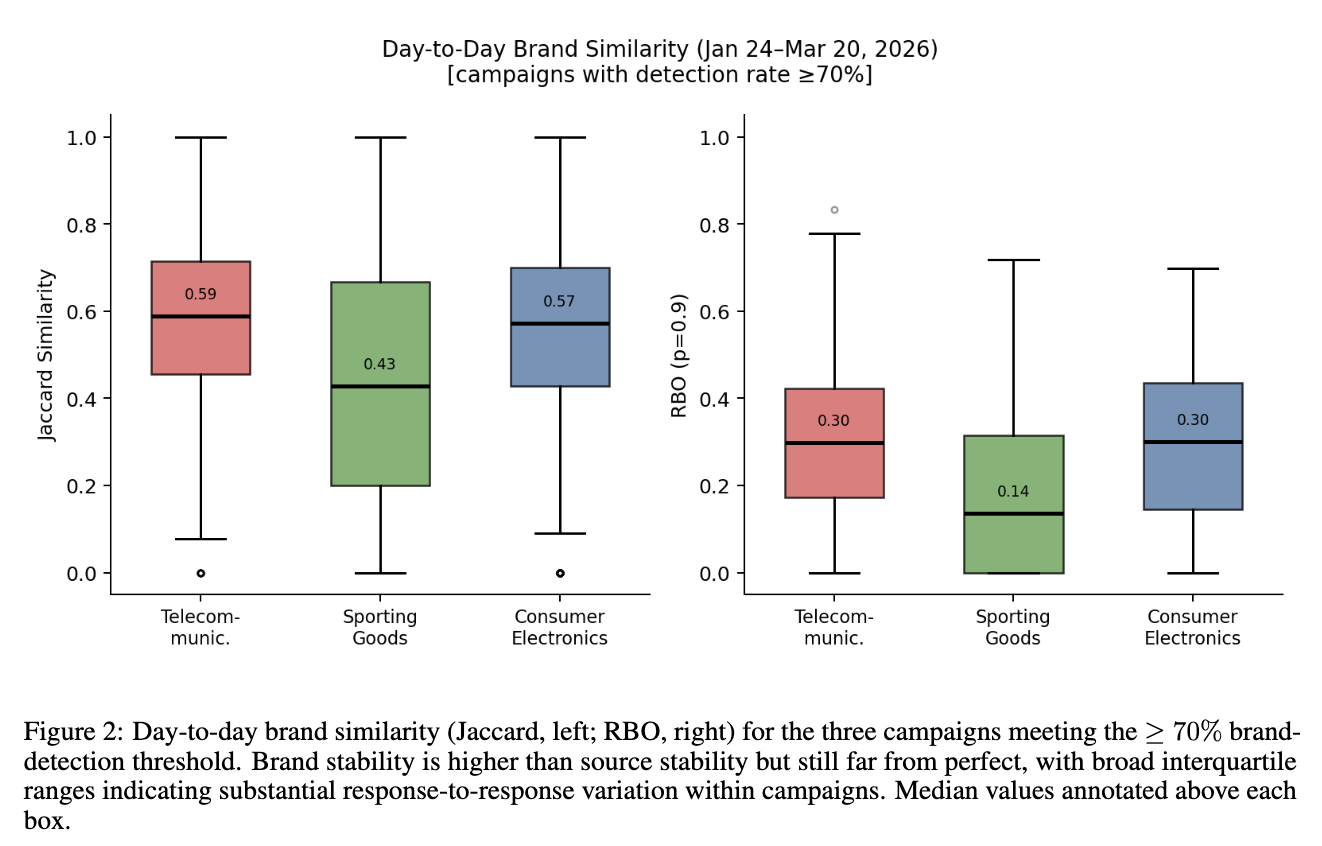
Brand mentions are more stable than cited sources but still show broad interquartile ranges, indicating substantial response-to-response variation within campaigns.
Figure 3 — Citation concentration (Gini coefficient)
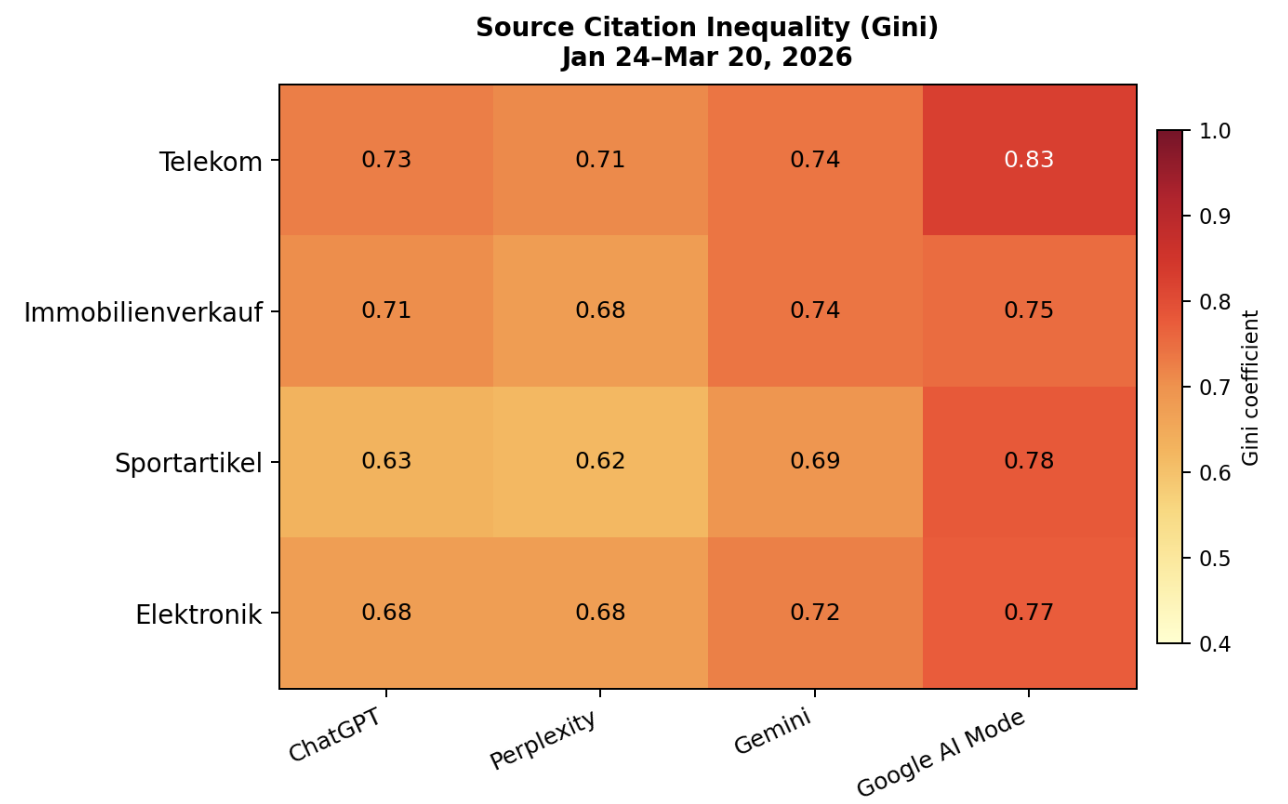
Across all campaigns and AI engines, citation is highly concentrated — a mean Gini of 0.715, meaning a small number of domains capture the vast majority of AI citations. This concentration has major implications for GEO strategy: link-building and content placement on high-authority domains matters enormously.
Figure 4 — Same-day repeated-run similarity
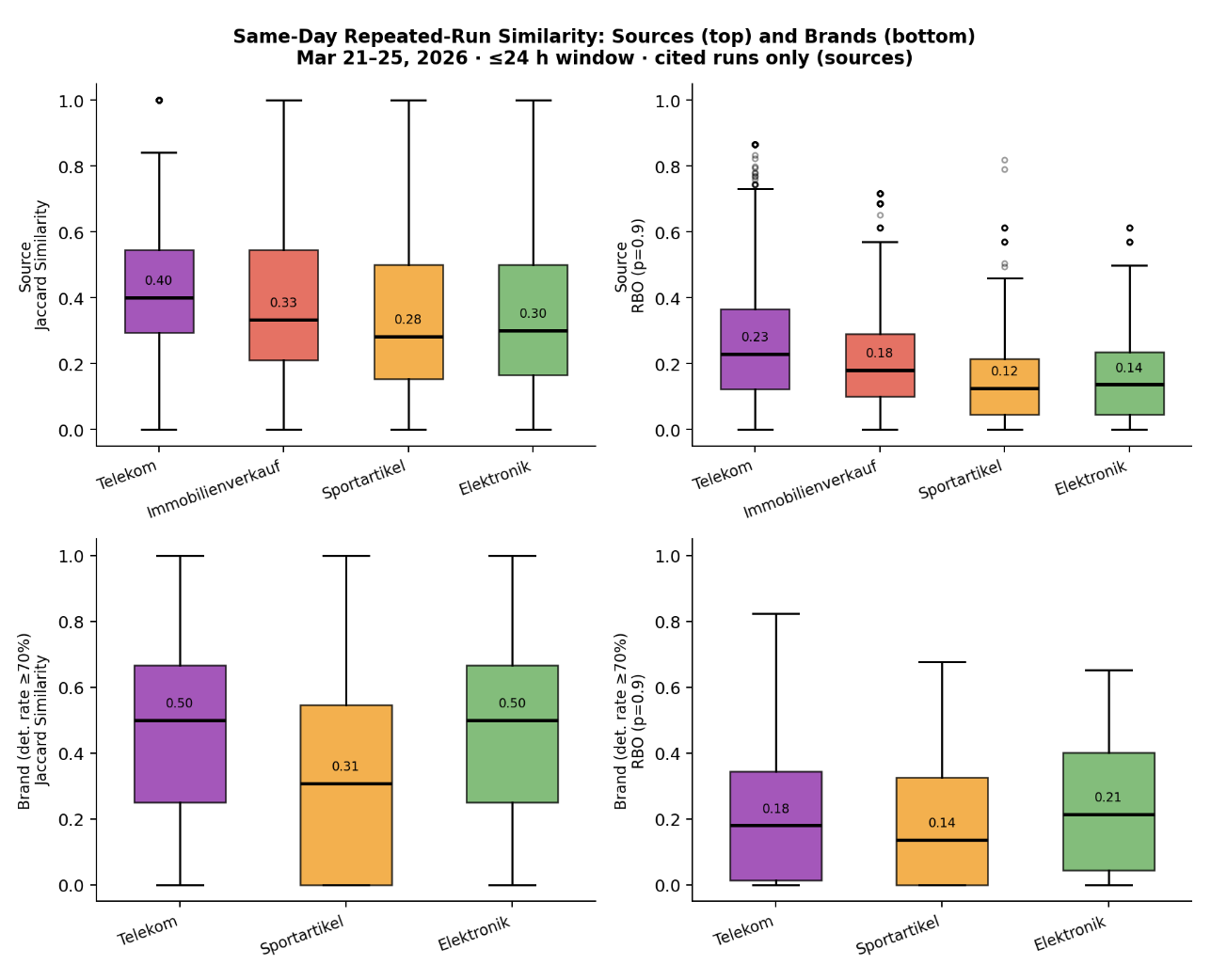
Source sets overlap by only 28–40% even within a single day (repeated runs, Mar 21–25, 2026), with brand overlap following a similar pattern. The standard error of the estimated per-brand detection rate falls below 0.10 at n = 7 runs per prompt. Source coverage stabilises at n = 8 runs. This is the paper's key practical recommendation: run each prompt at least 7–8 times before drawing conclusions.
Rolling window length A rolling window of ≥ 24 days brings the standard error below 0.05. To achieve high-precision monitoring (SE < 0.02), a window of ≥ 34 days is required. Single-day or single-week snapshots are statistically unreliable.