
What is GEO optimization?
GEO optimization (generative engine optimization) means positioning your content, your brand, and the sources about your brand so that AI assistants such as ChatGPT, Perplexity, Google AI Overviews, Google AI Mode, Gemini, and Microsoft Copilot mention you in their answers, recommend you, and link to you as a source.
The term comes from a research paper by Princeton University and partners, published in 2023 and presented at KDD 2024. In practice, several names are used for the same goal: AEO (answer engine optimization), LLMO (large language model optimization, common in Switzerland), or simply AI SEO.
The difference from classic SEO: it is no longer just about a spot in a list of links, but about being part of the generated answer. If you are missing there, many users will not see you at all.
“…we demonstrate that GEO can boost visibility by up to 40% in generative engine responses.”Why GEO optimization matters now
Search is shifting into the answer. The numbers from Germany, Switzerland, and the US all point in the same direction:
- 50% of Germans use an AI chat at least occasionally instead of classic internet search (Bitkom, November 2025).
- When Google shows an AI summary, users click a traditional search result in only 8% of visits – compared with 15% without a summary. They click the sources within the summary itself in just 1% of visits (Pew Research Center, July 2025).
- According to Ahrefs, the presence of an AI Overview is associated with a 58% lower click-through rate (Ahrefs, February 2026).
- Seer Interactive measures an organic click-through rate that has dropped by almost two thirds for queries with AI Overviews (Seer Interactive, November 2025).
- In Switzerland, 58% of SMEs have never checked what information AI gives about their company (KMU Digital Pulse 2026, localsearch/HSLU).
For brands, this means visibility increasingly happens in the answer itself – even without a click. If you measure and optimize today, you secure your position before the source landscape in your own category solidifies.
“Der Traffic, der jetzt zu Google wandert, kommt nie wieder zurück.”Translation: The traffic that is now moving to Google will never come back.
GEO vs. SEO: What changes – and what stays the same
GEO does not replace SEO; it builds on it. Most AI assistants with web search pull their information from search indexes, so if you are not indexed and findable, you will not be cited either. What differs is the goal, the result, and the measurement:
In short: SEO determines whether your pages are found. GEO determines whether the answer includes your brand – and whether it represents you correctly.
| Aspect | SEO | GEO |
|---|---|---|
| Goal | High position in search results | Mention and recommendation in the AI answer |
| Result for users | List of links | Summarized answer with a few sources |
| Unit of optimization | Keyword | Prompt (question in natural language) |
| Key signals | Relevance, backlinks, technical setup | Third-party sources, citable facts, entities, freshness |
| Metric | Ranking, clicks | Visibility, share of voice, citations |
| Stability | Rankings relatively stable | Answers vary with every query |
How AI assistants choose brands
An AI assistant draws on two sources of knowledge: what the language model learned during training and, when web search is active, pages it retrieves in real time (retrieval). To produce an answer, it often breaks the question into several sub-searches (query fan-out), reads the sources it finds, and summarizes them.
Whether your brand ends up in the answer therefore depends mainly on these factors:
- Third-party sources: Comparison articles, reviews, rating portals, industry directories, Wikipedia, and forums such as Reddit shape which providers are considered relevant.
- Clear, citable statements: Pages that answer a question directly – with facts, numbers, tables, and unambiguous wording – are more likely to be picked up.
- Consistent entities: Name, offering, prices, and location should be described identically everywhere – on your website, in structured data, and in external profiles.
- Freshness: For time-related questions ("2026," "current," "best"), search systems prefer fresh, dated content.
Important: AI answers are not deterministic. The same question produces a slightly different answer on every run – and even small rewordings change which brands are mentioned.
“Even minor prompt rephrasings can dramatically alter which brands get mentioned.”8 GEO optimization measures
In practice, these measures have the greatest leverage. They build on one another – start with measurement and source analysis, not with producing text.
- 1. Prompt research instead of a keyword list: Collect the questions your customers actually ask AI assistants – including comparison and purchase-decision questions ("Which tool is best for …?").
- 2. Source analysis: Find out which pages the assistants cite in your category. These are your most important levers – often not your own website, but comparison portals, trade media, and directories.
- 3. Answer-ready content: Start pages with a direct one-sentence answer, supplemented by facts, comparison tables, and FAQs. Name your brand and your offering explicitly.
- 4. Structured data & entities: Add Schema.org markup (Organization, Product, FAQPage, Article) and keep company facts identical across all profiles.
- 5. Presence in third-party sources: Make sure you appear in the comparison articles, rating portals, and trade publications that the assistants cite – through PR, guest posts, customer reviews, and partnerships.
- 6. Technical accessibility: Allow AI crawlers such as GPTBot, OAI-SearchBot, PerplexityBot, and Google-Extended in your robots.txt, deliver content server-side, and keep load times short.
- 7. Freshness: Date your most important pages, update figures and prices regularly, and visibly mark revisions.
- 8. Multilingual content: AI assistants answer in the language of the question. For DACH, France, and international markets, you need dedicated content in German, French, and English – not just translated navigation.
Measuring GEO success: the right metrics
GEO can be measured – but not like a classic ranking. Because answers vary with every run, a single query is worthless. What matters is only how often your brand appears across many prompts and repeated runs.
These metrics belong in every GEO report:
- Visibility (mention rate): The share of answers in which your brand is mentioned.
- Share of voice: Your share of all brand mentions compared with your competitors.
- Citation rate: How often your own pages are linked as a source.
- Position and context: Whether you are mentioned as the first recommendation or in passing – and with what tone (sentiment).
- Coverage per assistant: ChatGPT, Perplexity, Google AI Overviews, Google AI Mode, Gemini, and Copilot behave differently – measure them separately.
- AI referral traffic: Visits from chatgpt.com, perplexity.ai, and others in your web analytics – incomplete, but directly observable.
“AI Visibility is measurable. The mistake is running it like a rank tracker.”“…visibility % across dozens to hundreds of prompts run multiple times is a reasonable metric.”Measuring GEO optimization with Aurora
Aurora is a GEO platform from Switzerland that collects exactly these metrics automatically. Here is how it works:
- Define prompts: You define your target audience's questions – Prompt Intelligence shows which prompts your customers actually ask AI assistants.
- Measure daily: Aurora automatically submits the prompts to ChatGPT, Perplexity, Google AI Overviews, Google AI Mode, Gemini, and Copilot and analyzes the answers (Brand Visibility).
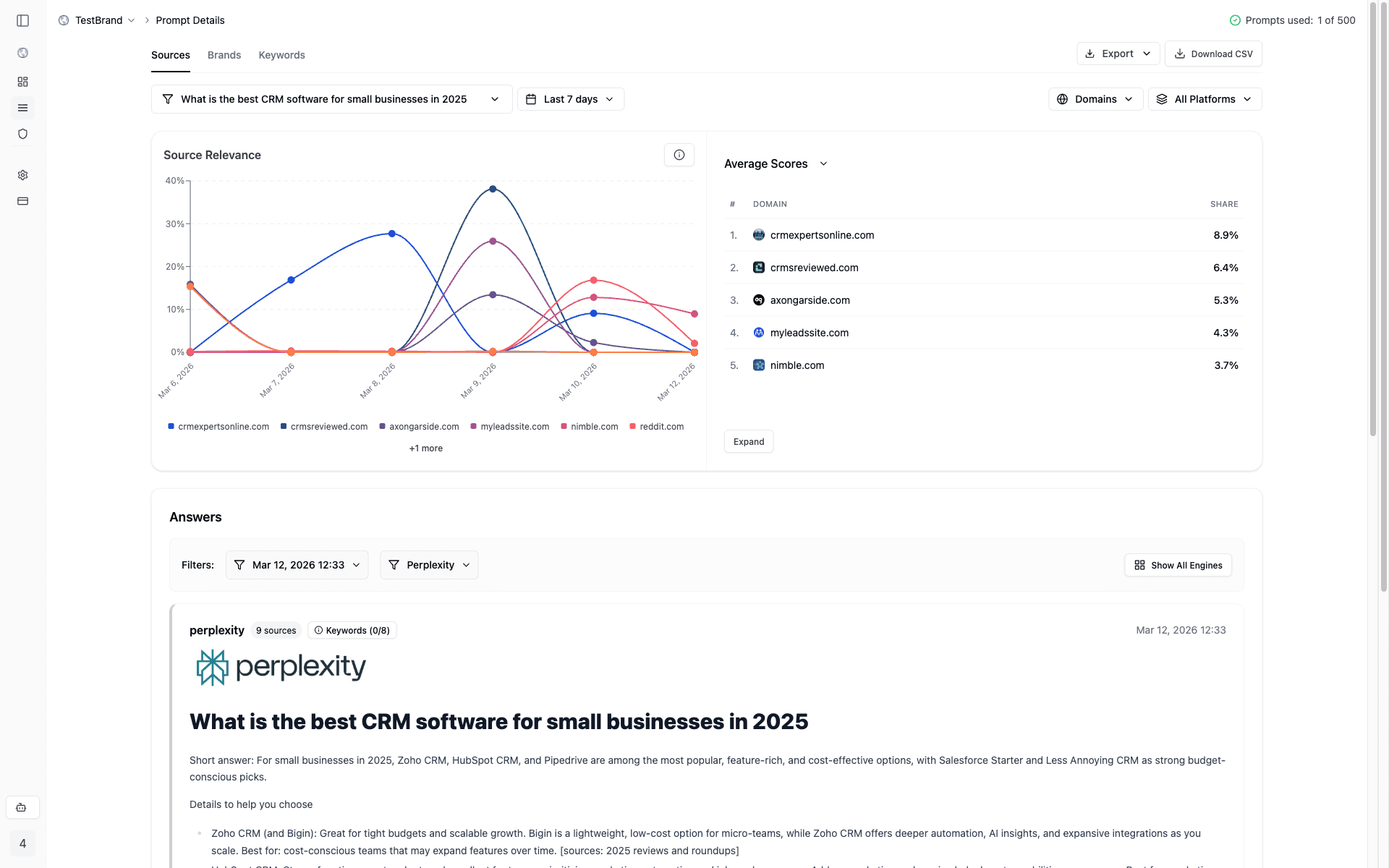
- Understand sources: The source analysis shows which pages the assistants cite – and suggests concrete actions, such as a guest post or inclusion in a comparison article.
- Prove progress: Visibility, share of voice, and citations over time – exportable as CSV/Excel or directly into Looker Studio.
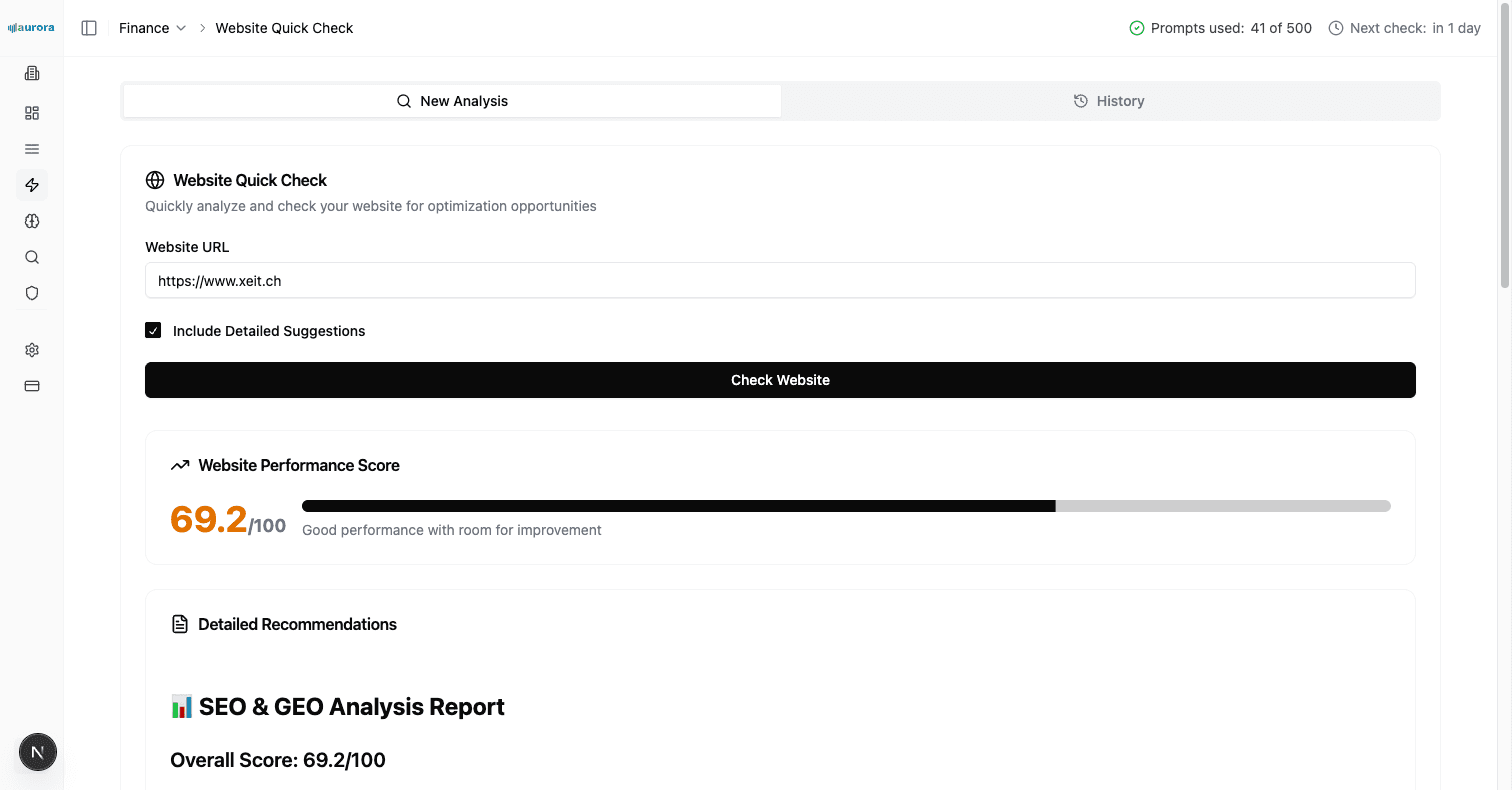
The free GEO check is the fastest way to get started: in about ten seconds and without an account, it shows whether AI assistants recommend your brand. If you want to compare different tools, you will find our overview at The best GEO tools compared.


Common mistakes in GEO optimization
These are the mistakes we see most often in projects:
- One-off checks: A single query in ChatGPT tells you nothing – answers fluctuate from run to run.
- Only one assistant: If you only check ChatGPT, you miss Google AI Overviews and AI Mode, which are directly visible in Google searches.
- Measuring only traffic: Clicks from AI answers are rare; visibility in the answer is the real currency.
- Keyword thinking: Prompts are longer, more specific, and more comparative than search terms – optimize for questions, not for keywords.
- Ignoring third-party sources: Your own website alone is rarely enough. What matters is what others write about you.
- English only: If you sell in the DACH region or in France, you need to be visible in your customers' language.
“Users don't click AI citations.”Your 90-day plan for GEO optimization
A pragmatic start in three phases:
- Days 1–30 – Measure: Define 30 to 100 relevant prompts, establish baseline values for visibility and share of voice across all assistants, and identify the most-cited sources in your category.
- Days 31–60 – Foundations: Make core pages answer-ready (direct answer, facts, FAQ), add structured data, allow AI crawlers, and align company facts across all profiles.
- Days 61–90 – Win sources: Initiate inclusion in the most important comparison articles and directories, collect reviews, place trade articles – and measure the impact on visibility and citations.
After that, GEO becomes an ongoing process: measure monthly, close gaps, and keep content up to date.
Frequently asked questions about GEO optimization
- What is GEO optimization?
- GEO optimization (generative engine optimization) is the optimization of content, brand, and external sources with the goal of being mentioned, recommended, and cited in answers from AI assistants such as ChatGPT, Perplexity, Google AI Overviews, Gemini, and Copilot. Synonyms are AEO, LLMO, and AI SEO.
- What is the difference between GEO and SEO?
- SEO aims for high positions in a list of search results; GEO aims for a mention within a generated answer. GEO builds on SEO because AI assistants with web search draw their sources from search indexes – in addition, third-party sources, citable facts, and consistent company information matter.
- How long does it take for GEO measures to work?
- For assistants with web search (Perplexity, Google AI Overviews, ChatGPT search), changes can show up as soon as the affected pages are re-crawled – often within a few weeks. What a model knows from its training data, on the other hand, only changes with new model versions. Plan for several months and measure continuously.
- How much does GEO optimization cost?
- The costs consist of measurement (a GEO tool) and implementation (content, PR, technical work – in-house or with an agency). Aurora costs from CHF 19 per month (Light, 15 prompts) and CHF 199 per month on the Pro plan with 200 prompts; all plans can be tested free for 14 days. You can find a price comparison of other providers in our GEO tool comparison.
- Can I do GEO optimization myself?
- Yes. Most measures – answer-ready content, structured data, maintaining profiles and reviews – can be implemented in-house. What matters is reliable measurement across many prompts and assistants, so you can see what works.
- Do I need an llms.txt file?
- An llms.txt file does no harm and is quick to create, but it does not replace any of the important measures. What matters are indexable, answer-ready content, presence in cited third-party sources, and access for AI crawlers via robots.txt.
- How do I measure whether ChatGPT recommends my brand?
- Ask the questions relevant to you repeatedly and in large numbers, and evaluate the share of answers in which your brand appears. A GEO tool like Aurora automates this daily for ChatGPT, Perplexity, Google AI Overviews, Google AI Mode, Gemini, and Copilot. The free GEO check, which requires no sign-up, gives you a first impression.
Sources
Every quote was checked against the original (retrieved October 2026). Quotes appear in their original language.
- Aggarwal, Murahari, Rajpurohit, Kalyan, Narasimhan, Deshpande: GEO: Generative Engine Optimization. arXiv / KDD 2024, Nov 16, 2023.
- Internet-Suche im Wandel: Die Hälfte nutzt bereits KI-Chats. Bitkom, Nov 20, 2025.
- Athena Chapekis, Anna Lieb: Google users are less likely to click on links when an AI summary appears in the results. Pew Research Center, Jul 22, 2025.
- Ryan Law: Update: AI Overviews Reduce Clicks by 58%. Ahrefs, Feb 4, 2026.
- Tracy McDonald: AIO Impact on Google CTR: September 2025 Update. Seer Interactive, Nov 4, 2025.
- Roland Eisenbrand: 265 Millionen Klicks weg? Diese Seiten verlieren wegen AI Overviews am stärksten Traffic. OMR Daily, Mar 26, 2026.
- Studie KMU Digital Pulse 2026: Schweizer KMU sind noch nicht im KI-Zeitalter angekommen. Handelsverband.swiss (localsearch / HSLU), Sep 29, 2026.
- Rand Fishkin: NEW Research: AIs are highly inconsistent when recommending brands or products; marketers should take care when tracking AI visibility. SparkToro, Jan 28, 2026.
- Dave Friedman: Large Language Models Are Not Search Engines. Buy the Rumor; Sell the News (Substack), Jul 3, 2025.
- Kevin Indig: Make your prompt tracking more accurate this week. Growth Memo (Substack), Jun 8, 2026.
- Kevin Indig: How to measure the impact of AI search the right way. Growth Unhinged (Substack), Jul 15, 2026.