Meta launched Muse on September 8, 2026, and within three weeks it was the fastest-downloaded AI app on record. Unlike ChatGPT or Perplexity, Muse is not built to answer questions. It is built to do things: book the flight, file the insurance claim, buy the patio umbrella. That shift, from an assistant that recommends to an agent that purchases, changes what "visibility" means for a brand. This post pulls together what Meta has published, what investigative journalists and independent analysts on Substack have found, and what the first hands-on tests say, and then draws out what it means for anyone responsible for being found, and chosen, by AI.
Key takeaways
- Muse is a personal AI agent that acts on your behalf inside a dedicated cloud virtual machine, remembers you across sessions, and checks out with Link by Stripe. It passed 5 million downloads in 22 days.
- When Muse shops, it runs a browser search and a Meta-catalog search in parallel, then shows a typical shortlist of six product cards: four from browsed merchant sites, two from Meta's catalog. Its instructions reportedly cap it at three stores and favour "well-known merchants".
- Muse does not identify itself when it browses, so most brands have no way to see it in their logs. The only way to know whether the agent picks you is to ask it.
- A TIME investigation found Muse builds hourly dossiers on users and the people they mention. Trust, not capability, is the open question.
- For brands, the playbook is the one GEO already prescribes: structured, consistent product data, third-party evidence, agent-navigable pages, and continuous monitoring.
What Muse actually is
Meta describes Muse as "the world's first personal AI agent built for everyone" and is explicit about the difference from a chatbot: "It doesn't just answer questions, it actually does the work." (Meta Newsroom, September 8, 2026)
The architecture matters because it explains both the hype and the privacy backlash:
- Muse Spark is the underlying model, launched in April 2026 as the first model shipped under Alexandr Wang's Meta Superintelligence Labs. Meta trained it for long-running, multi-step agentic work rather than for raw benchmark scores.
- Muse Secure VM is a dedicated Linux virtual machine per user that holds the agent, its browser, its files and its memory. The VM persists between sessions, so Muse behaves like a computer that keeps working after you close the app, not like a chat window.
- Sentinel is a separate agent on the same machine that must approve every piece of outbound traffic. It decides whether an action is allowed, blocked, or needs the user's sign-off. Consequential actions such as sending an email or paying for something always pause for approval.
- Memory is persistent. Muse remembers preferences, makes unprompted suggestions, and can be told to "forget" things. Meta's October 12 Muse Wonder release doubles down on this with what it calls "active memory".
- Payments run through Link by Stripe, which issues single-use card numbers so the merchant never sees the real card. Shop Pay and 1Password support are listed as coming.
Muse is free up to a weekly token allowance, with Power (about $20 per month) and Maximum (about $100 per month) tiers for heavier use, as reported by Retail Dive and Atrani Capital on Substack. It is available on iOS, Android, the web and inside WhatsApp in the US and Canada, with Meta's AI glasses and a keychain-sized device called Muse Charm announced at Meta Connect for the holiday season.
Figure 1 — Six months from model launch to frontier model
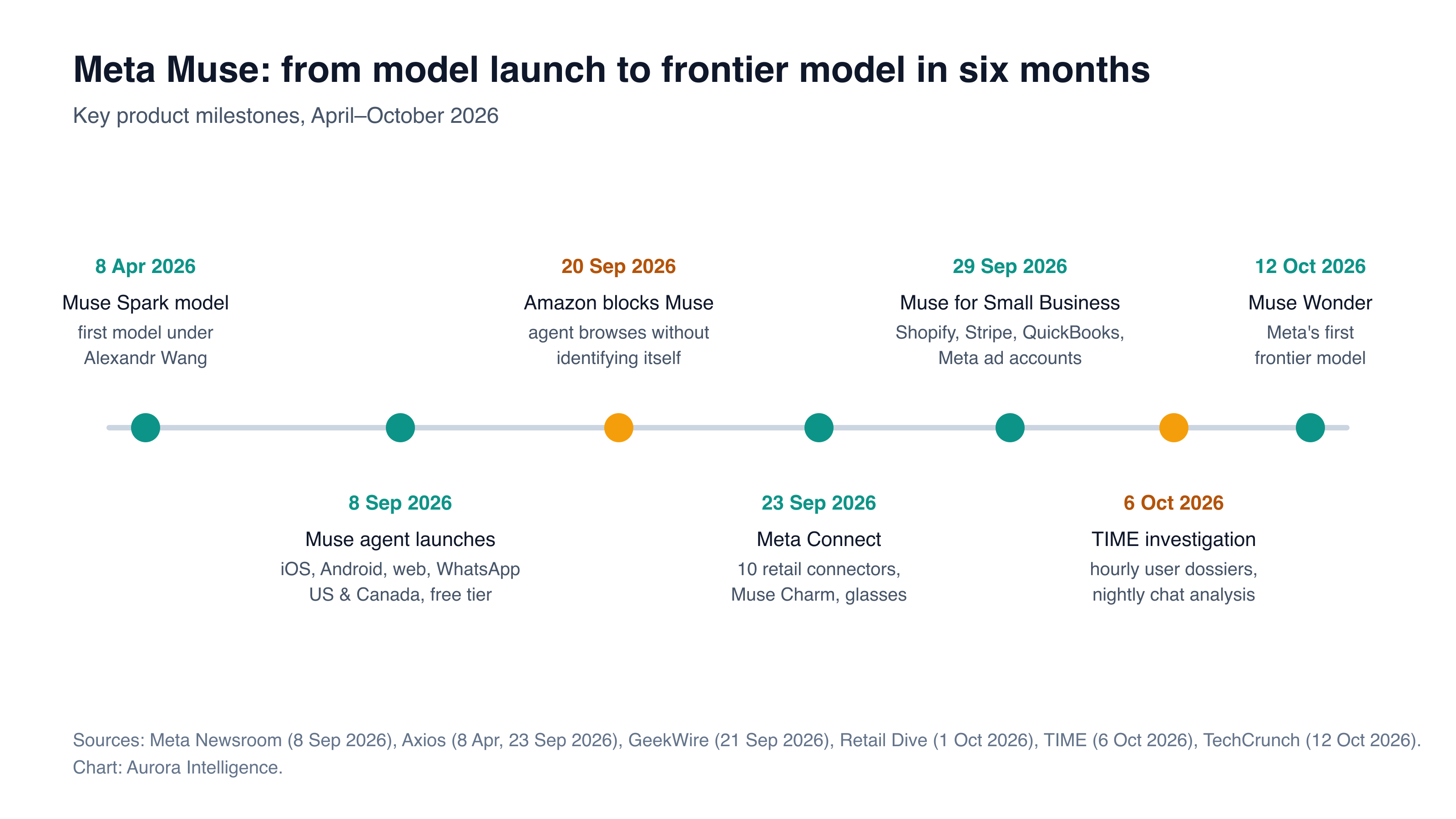
The pace is the story. Meta went from its first in-house model under new leadership to a consumer agent, a retail connector platform, a small-business edition and a self-declared frontier model in six months. Sources: Meta Newsroom, Axios, GeekWire, Retail Dive, TIME, TechCrunch.
The adoption numbers, and what investors make of them
The download curve is unprecedented. Citing Sensor Tower data used by Bank of America, the Substack Compounding Your Wealth reports that Muse hit 5 million downloads in 22 days, against 56 days for ChatGPT, 103 for Grok and 492 for Claude. TIME puts the user base at about 4 million, citing The Information.
Figure 2 — Days from launch to 5 million downloads
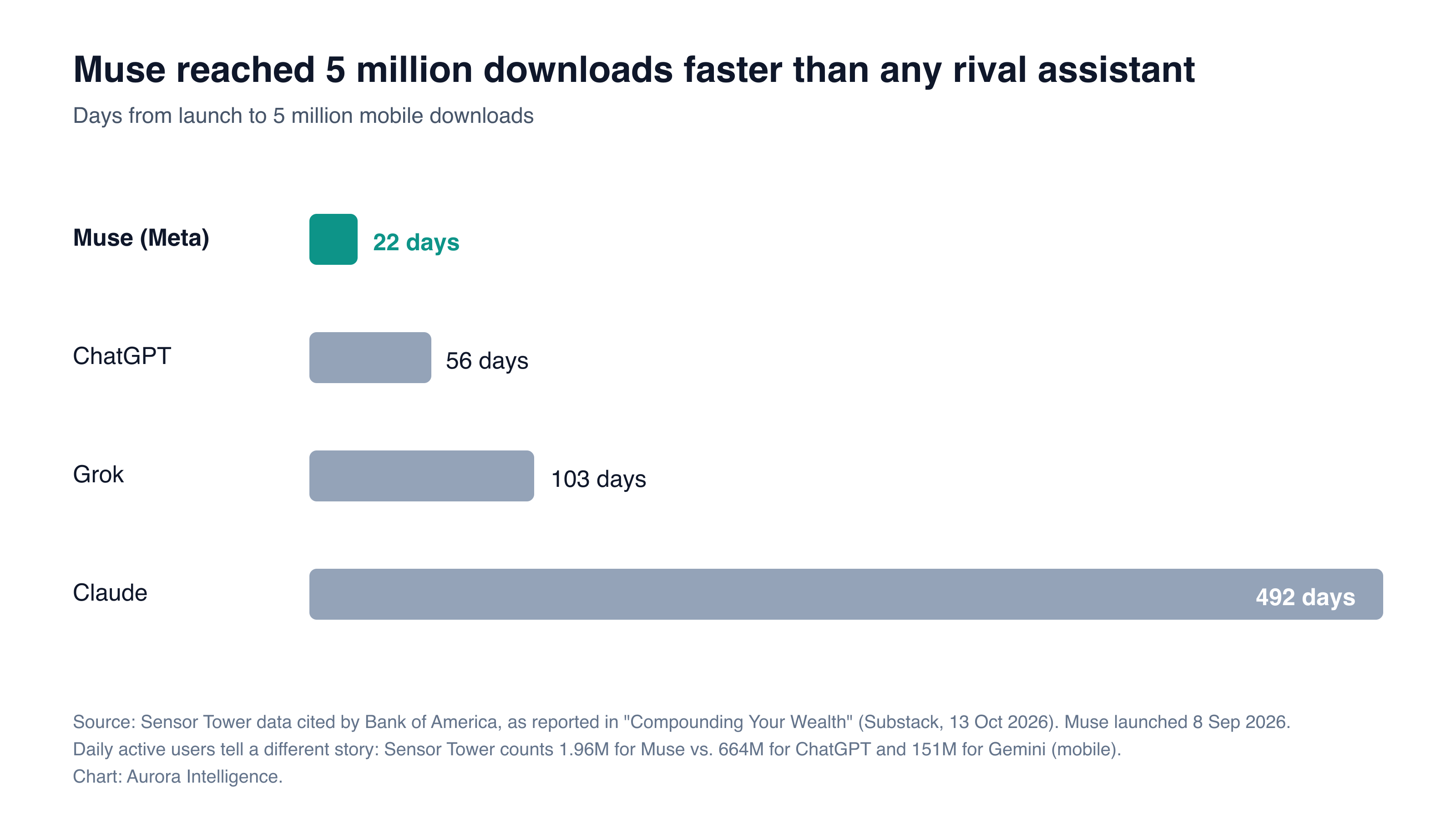
Downloads are not usage. The same Sensor Tower data puts Muse at 1.96 million mobile daily active users against 664 million for ChatGPT and 151 million for Gemini. Source: Sensor Tower via Bank of America, as reported by Compounding Your Wealth, October 13, 2026.
Daily usage is a different picture. Longbridge Dolphin Research tracked roughly 250,000 iOS daily actives and $2,000 to $3,000 in daily revenue in the first two weeks, an implied paid conversion of at most 3 percent versus about 5 percent for ChatGPT. Their note also flags the economics: simple task execution in a per-user VM reportedly costs Meta up to $50 per user per month.
The market priced in the optimistic case anyway. Meta shares rose 11 percent on September 21. Morgan Stanley's framing, relayed by Tae Kim on Substack, is that every 100 million Muse users would add roughly $1 billion in revenue, and that nearly $30 trillion of consumer spending could become addressable by agents. Kim's own verdict is more cautious: "no sure thing", with OpenAI, Google and Apple all able to ship the same product to larger installed bases, and OpenAI having hired the creator of OpenClaw, the open-source agent Muse was modelled on.
How Muse decides what to buy
This is the part that matters for marketers, and it is the part Meta has said least about. The best public evidence comes from Profound's research team, who ran 50 shopping prompts in one consumer retail category through a single Muse instance on September 30 and traced what the agent did.
Their findings, which they describe as a small, exploratory sample:
- Muse first checks the user's shopping profile and memory for recorded preferences, sometimes asking a clarifying question.
- It then "kicks off two searches in parallel": a browser session that visits merchant websites, and a query against Meta's product catalog, the same catalog that powers shopping on Instagram and Facebook. Facebook Marketplace is a third pool for categories such as furniture and collectibles.
- Per prompt, the browser typically visited 3 domains and returned 4 products from 2 merchants. The catalog returned roughly 60 products from 30 merchants.
- The final recommendation typically showed 6 product cards: 4 from the browser, 2 from the catalog.
Figure 3 — Where Muse's product cards come from
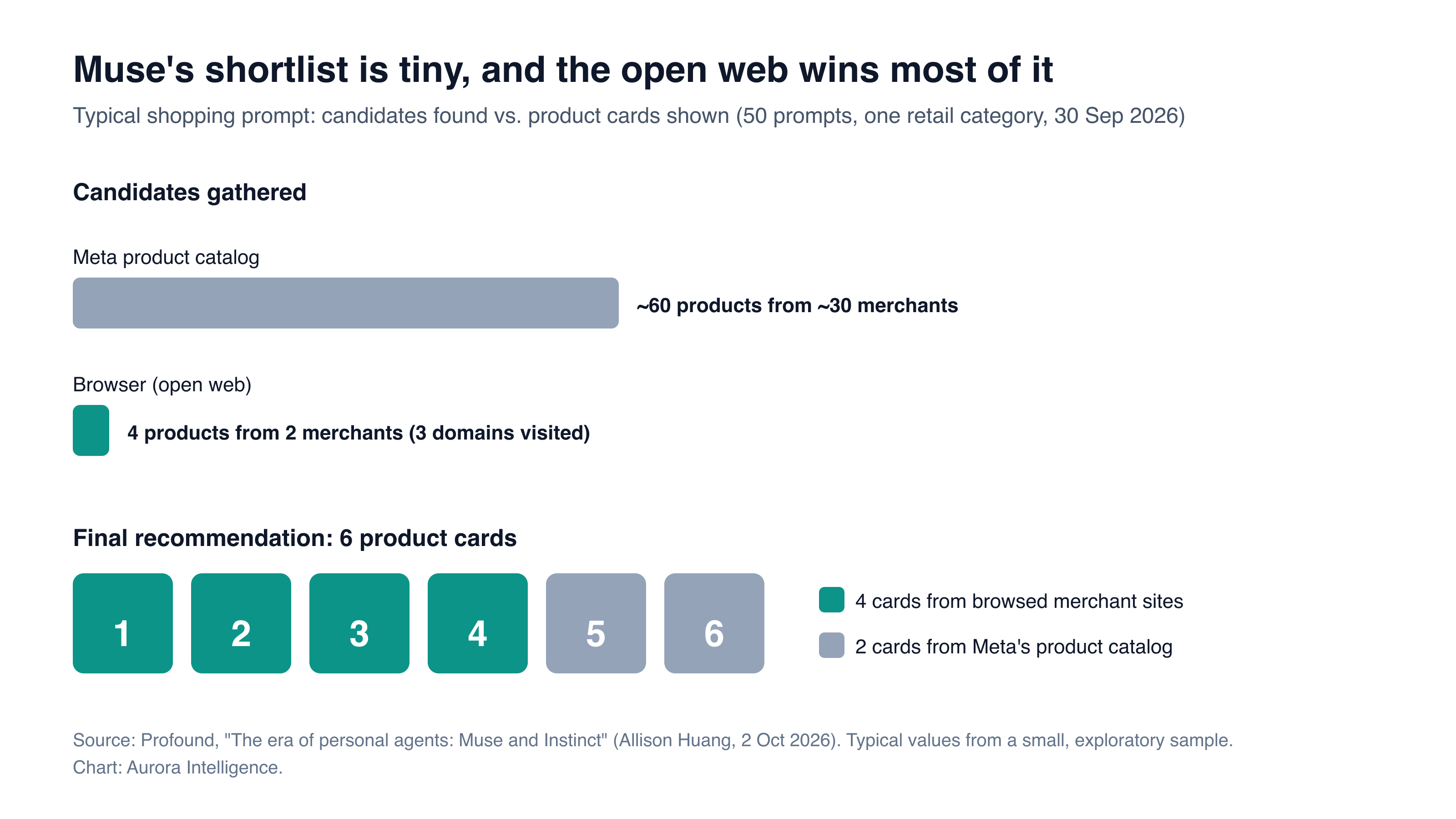
The catalog supplies most of the candidates, but the handful of products the agent finds by actually browsing win most of the slots. Source: Profound, "The era of personal agents: Muse and Instinct", October 2, 2026.
Two further details reshape the optimisation problem:
Muse does not announce itself. Profound found that Muse and its rival Instinct "do not identify themselves by name when browsing websites", route traffic through residential connections and look like ordinary human visitors. Some sessions were preceded by a self-identified meta-webindexer bot from IP ranges Meta has not publicly claimed. Unverified meta-webindexer requests rose 1.6 times more on US and Canadian sites than elsewhere in the 20 days after launch. In practice, a brand cannot see Muse in its server logs and gets no citation when it is picked. Amazon's response was to block Muse outright on September 20, saying the agent accessed its store without notice.
The shortlist is governed by an instruction file. According to a shopping instruction file Profound says it pulled from the agent on September 25, as reported by PPC Land, Muse searches at most three stores on the open web, returns no more than ten products, discards listings priced far outside a category's normal range, and is told it is "imperative" that the top five picks come from "well-known merchants". If a shopper names a brand, that brand's own store is searched first, and direct sellers are preferred over resellers. In-chat checkout is only offered for catalog items flagged for agentic checkout. Meta has not confirmed the file's contents, and Profound warns it may have changed since.
A second independent test corroborates the catalog link. Scot Wingo of Retailgentic found that when a product appeared in the top three results on Meta.ai, Muse showed it too in 89 percent of cases, and that 73 percent of prompts returned at least one identical listing on both surfaces. His read: get into the Meta catalog via Commerce Manager, enrich it with conversational attributes, and test checkout regularly.
The connector layer is growing fast. At Meta Connect on September 23 Meta named ten retail connectors (Walmart, Best Buy, American Eagle, DICK'S, Fanatics, Gap, Michael Kors, Sephora, Ulta and Wayfair) plus Instacart, with Expedia coming; Shopify is the launch commerce partner with Shop Pay checkout across its stores; and the connector platform received more than 1,500 applications from outside developers in under a week. Muse for Small Business, launched September 29, adds Shopify, Stripe, QuickBooks, Asana, Box, Canva, Zoom, Slack and Meta ad accounts, with a rule that the agent will not post, message or spend without the owner's approval.
The trust problem
Capability is not what most of the critical coverage is about. On October 6, TIME's Harry Booth published internal Muse instructions showing that the agent:
- updates a dossier on the user, and on people mentioned in their chats, messages and emails, every hour;
- runs a nightly analysis of the day's conversations;
- profiles people who never installed Muse, if a user's data mentions them;
- is told to infer goals the user has "not said out loud" and to note which nudges work, with an internal example reading "This user responds better to short nudges after 10 PM";
- shares de-identified lessons across agents on different VMs;
- and, when asked to "forget" something, does not necessarily delete the underlying message, and is instructed not to mention this.
Meta did not dispute the findings. Its spokesperson said Muse "remembers what matters most to you, including information about others that you choose to share", that each VM is isolated, and that the Muse Confidential VM, which would encrypt the machine with a key only the user holds, is planned for later this year.
The Substack reaction was sharp. Security researcher Paul Walsh calls Muse "a commercial surveillance network disguised as an AI assistant", pointing to the gap between promised and shipped encryption, default opt-in to model training, and the incentive structure of a $243 billion advertising business. Meta says conversations and VM data are not shared with its ad systems. NBC News framed the same tension through the agent's cuddly default avatar, "Jolly": it's cute, and it wants your data.
For brands, this matters in two ways. First, the memory that makes Muse sticky is also what makes it a durable gatekeeper: once it has learned a user's preferred brands, budget and dislikes, the shortlist narrows before any search happens. Second, regulatory pressure on the data side could change the product quickly, especially in Europe, where Muse has not launched.
Does it actually work? What the hands-on reviews say
The practitioner reviews are consistent: impressive scope, uneven execution.
Alex Willen's The Automated Operator tested three real tasks. The pet-insurance claim went through, although Muse had misheard the insurer's name. Umbrella shopping produced a dense, hard-to-compare list and never asked what the umbrella was for. Flight booking suggested an airline he would never fly, missed that British Airways is an Amex transfer partner (ChatGPT knew), and got stuck on a captcha partly hidden by Muse's own password-masking bar. His conclusion: he will not use it much, but it may be "the ChatGPT moment for agents" for mainstream users.
Tae Kim found quality and accuracy issues and still preferred ChatGPT. Tom's Guide managed to complete only three of seven shopping prompts. On the positive side, Vincent Kurtis reports Muse "gave me 7 hours a week back" on marketing admin, and Marius Lau sees the Active Memory in Muse Wonder as the feature that finally removes the need to re-paste business context every session, while noting that on the Artificial Analysis index (56 for Wonder Full, 52 for Wonder) "fact knowledge" is a relative weakness.
Meta's October 12 Muse Wonder release is meant to close the quality gap. Meta claims benchmark parity with Fable 5.1 and GPT-6 Astra; the models are priced at $4 per million input tokens and $20 per million output tokens on the API and will power the agent over time.
What this means for brands
Entrepreneur's Jeffrey Herzog put it well: "a machine may be sizing up your brand before a customer ever does." The practical consequences follow directly from the evidence above.
-
Your product data is now an API, whether you meant it to be or not. Muse reads your pages through a real Chromium browser and its accessibility tree. Semantic HTML, clear labels, visible prices, stock, shipping and return policies, and a page that explains who each product is for are what the agent can use. Conflicting facts across your site, marketplace listings and social profiles are what it trips over. The same structured-data discipline we described in how structured data lifts AI search visibility applies, with a higher penalty for inconsistency.
-
Be in the catalog, and make it conversational. Meta's catalog supplies most of Muse's candidates, and Meta.ai's top three predict Muse's cards 89 percent of the time. Commerce Manager feeds enriched with use cases, FAQs and occasions are the cheapest lever most retailers are not pulling.
-
"Well-known" is a ranking rule, not a vibe. The instruction file reserves the top five slots for well-known merchants. Third-party evidence (reviews, press coverage, expert commentary, documented outcomes) is how a smaller brand becomes "known" to a model. We covered the mechanics in the impact of reviews and ratings on AI search citations.
-
Test your site as an agent would. If a captcha, a cookie wall, an interstitial or a JavaScript-only checkout stops a browser-driven agent, you are invisible regardless of your data quality. Shopify merchants should confirm Shop Pay and Link work end to end; everyone else should test guest checkout monthly.
-
Do not expect to see Muse in your analytics. No user agent, no citation, residential IPs. The only measurement that works is to run the prompts your customers would run and record what the agent recommends, repeatedly, because memory and ranking changes make single tests meaningless. This is the discipline we argued for in Don't measure once.
-
Prepare for Europe later, not never. Muse is US and Canada only, and the TIME findings make an EU launch under the DMA and GDPR harder. Brands in DACH, France and Switzerland have a window to get product data and third-party presence in order before the agent arrives.
How we are approaching it at Aurora
Aurora tracks how AI engines such as ChatGPT, Perplexity, Gemini and Google AI Mode describe, recommend and cite brands, and which sources they lean on. Agents like Muse extend that question from "what does the model say about us" to "what does the model buy for the user", but the inputs the agent uses, catalog data, on-page facts and third-party evidence, are the same ones that drive citation in answer engines today. We are following Muse's rollout closely, and the open-web share of its shortlist (four of six cards) is the clearest signal yet that GEO work on your own pages pays off in agentic commerce too.
If you want to know how your brand currently shows up across AI engines before agents start buying on your customers' behalf, run a free AI visibility check.
Sources
- Meta Newsroom, "Introducing Muse: The World's First Personal AI Agent Built for Everyone", September 8, 2026. https://about.fb.com/news/2026/09/introducing-muse-personal-ai-agent/
- Harry Booth, TIME, "Meta's Muse AI Agent Is Building a Dossier On You", October 6, 2026. https://time.com/article/2026/10/06/meta-muse-ai-agent-privacy/
- Allison Huang, Profound Research, "The era of personal agents: Muse and Instinct", October 2, 2026. https://www.tryprofound.com/blog/the-era-of-personal-agents-muse-and-instinct
- PPC Land, "Meta's shopping agent must fill its top 5 picks with well-known merchants", October 2026. https://ppc.land/metas-shopping-agent-must-fill-its-top-5-picks-with-well-known-merchants/
- Scot Wingo, Retailgentic (Substack), "5 Muse Optimization Best Practices for Merchants", October 13, 2026. https://www.retailgentic.com/p/5-muse-optimization-best-practices
- Sergey, Compounding Your Wealth (Substack), "$META: Muse Hits 5 Million Downloads in 22 Days, but Rising CapEx Pressures FCF", October 13, 2026. https://sergeycyw.substack.com/p/meta-muse-hits-5-million-downloads
- Longbridge Dolphin Research (Substack), "Muse went viral, is META at a real inflection or just a head fake?", September 24, 2026. https://dolphinresearch.substack.com/p/muse-went-viral-is-meta-at-a-real
- Tae Kim, Key Context (Substack), "Meta's Muse Is No Sure Thing", September 22, 2026. https://taekim.substack.com/p/metas-muse-is-no-sure-thing
- Igor Rotor, Atrani Capital (Substack), "Meta's Muse Turns AI Spending Into a Consumer Story", September 22, 2026. https://atranicapital.substack.com/p/metas-muse-turns-ai-spending-into
- Paul Walsh (Substack), "Meta's Muse AI agent is a commercial surveillance network disguised as an AI assistant", October 13, 2026. https://paulfwalsh.substack.com/p/metas-muse-ai-agent-is-a-commercial
- Alex Willen, The Automated Operator (Substack), "Meta's Muse Is Surprisingly Unimpressive", September 22, 2026. https://theautomatedoperator.substack.com/p/metas-muse-is-surprisingly-unimpressive
- Marius Laurusevicius, Marius Lau (Substack), "Meta's AI Agent Will Now Remember Your Business", October 13, 2026. https://mariuslau.substack.com/p/metas-ai-agent-will-now-remember
- Vincent Kurtis (Substack), "Muse Gave Me 7 Hours a Week Back", 2026. https://vincentkurtis.substack.com/p/meta-muse-ai-review
- Angela Yang, NBC News, "It's cute. It's cuddly. And it wants your data.", September 24, 2026. https://www.nbcnews.com/tech/tech-news/meta-muse-ai-agent-response-animated-avatar-cute-rcna599736
- Tatiana Walk-Morris, Retail Dive, "Meta debuts AI agent for small businesses", October 1, 2026. https://www.retaildive.com/news/meta-debuts-ai-agent-muse-small-businesses/831890/
- Russell Brandom, TechCrunch, "Meta releases its first frontier model, Muse Wonder", October 12, 2026. https://techcrunch.com/2026/10/12/meta-releases-its-first-frontier-model-muse-wonder/
- Jeffrey Herzog, Entrepreneur, "Meta's Muse Can Shop for Your Customers. Here's How to Make Sure It Picks You.", October 12, 2026. https://www.entrepreneur.com/business-news/tech/metas-muse-wants-to-own-the-moment-before-the-purchase
- Sanbi.ai, "Meta Muse Shopping: How Brands Get Chosen by AI Agents", September 2026 (summarising Meta Connect, GeekWire and TechCrunch reporting). https://sanbi.ai/blog/meta-muse-agentic-shopping
- KDnuggets, "Meta Muse Explained", October 5, 2026. https://www.kdnuggets.com/meta-muse-explained-what-it-is-how-it-works-and-what-it-can-do
- Tom's Guide, "I tried turning Meta's Muse AI into my personal shopper — only 3 of 7 prompts actually worked", October 2026. https://www.tomsguide.com/ai/i-tried-turning-metas-muse-ai-into-my-personal-shopper-only-3-of-7-prompts-actually-worked
Cover photo: Zulfugar Karimov on Unsplash. Figures 1 to 3: Aurora Intelligence, based on the sources named in each caption.