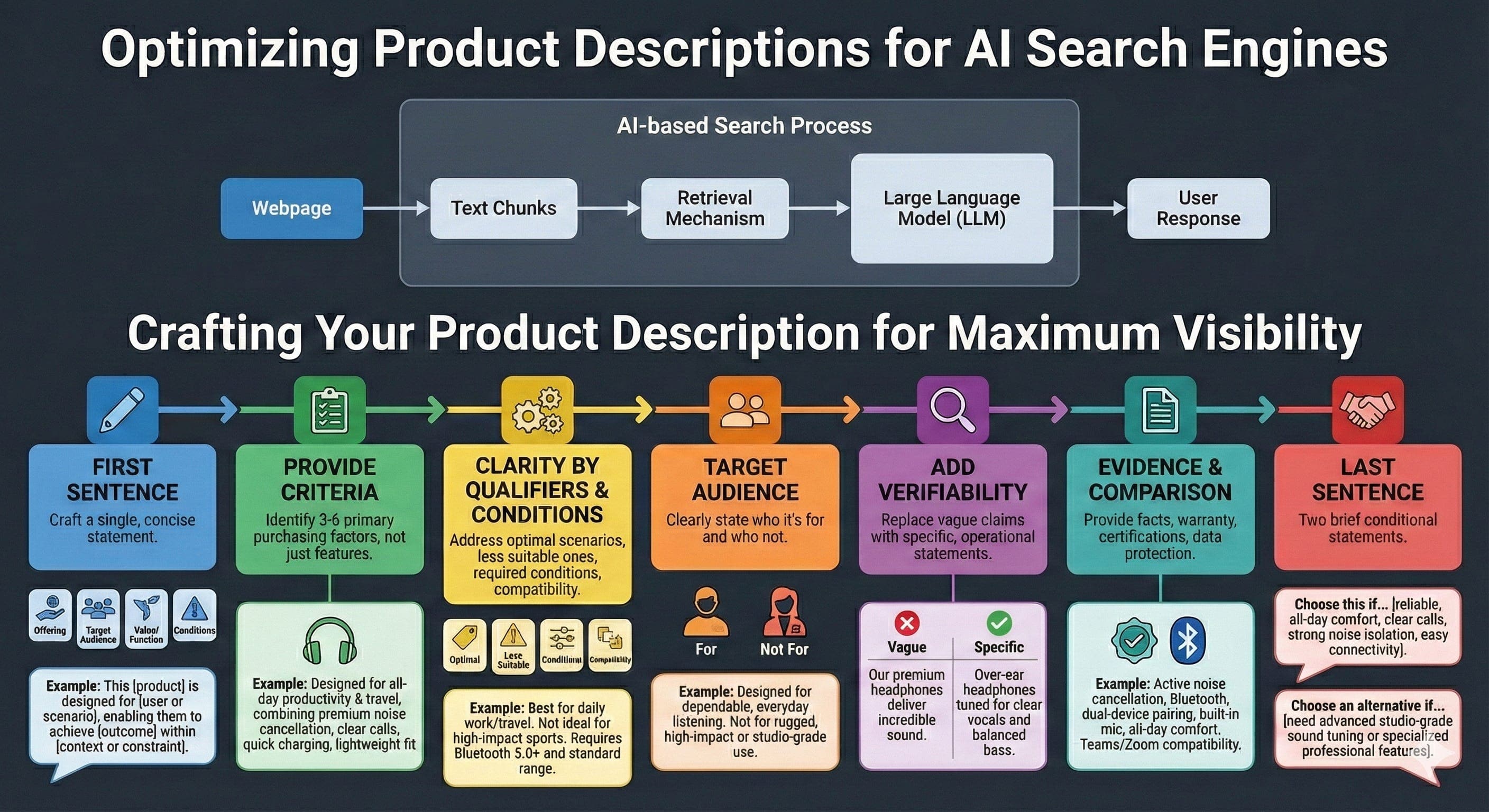
AI-based search engines use a retrieval mechanism paired with a Large Language Model (LLM) to answer user queries. The text chunks from your webpage significantly influence LLM responses. This guide outlines essential elements to maximize visibility in AI search results, with focus on product descriptions.
First Sentence
Craft a concise statement that articulates:
- What the offering is
- Its target audience
- The value or function it provides
- Conditions where it delivers greatest impact
Example: This [product] is designed for [user or scenario], enabling them to achieve [outcome] within [context or constraint].
Following Paragraphs or Text
Provide Criteria
Identify three to six primary purchasing decision factors relevant to your category. Define evaluation criteria rather than enumerate features.
Example: Designed for all-day productivity and travel, combining premium noise cancellation, clear call performance, quick charging, and a lightweight, comfortable fit.
Clarity by Qualifiers & Conditions
Address four key elements in straightforward language:
- Scenarios delivering optimal performance
- Situations where the product may be less suitable
- Operating conditions required for proper function
- Compatibility constraints
Example: Best for daily use in work and travel settings, offering reliable noise cancellation and clear audio for calls and music. Not ideal for high-impact sports or environments requiring full situational awareness. Performs best when paired via Bluetooth 5.0 or higher and kept within standard wireless range.
Target Audience
Explicitly state who the product is designed for and who it isn't.
Example: This is designed for listeners who want dependable, everyday headphones that deliver consistent audio quality and lasting comfort. It's not intended for users who need rugged, high-impact gear or specialized studio-grade monitoring equipment.
Add Verifiability
Product pages often fail by making vague claims. Adjectives like "durable," "powerful," or "premium" lack proof. Replace vague claims with specific operational statements showing how and under what conditions products perform.
Weak: Our premium headphones deliver incredible sound with all-day comfort.
Improved: Over-ear headphones tuned for clear vocals and balanced bass, designed to remain comfortable through long listening sessions with a lightweight build and breathable ear cushions.
Evidence & Comparison
Provide verifiable facts:
- Warranty details
- Safety certifications
- Product origin
- Data protection levels
Example: Active noise cancellation (if applicable), Bluetooth connectivity, dual-device pairing, built-in microphone with noise suppression, all-day comfort design, and compatibility with business tools such as Microsoft Teams and Zoom.
Last Sentence
End with two brief conditional statements clarifying ideal users and alternatives:
Format: "Choose this if..." [one short sentence about ideal user] + "Choose an alternative if..." [one short sentence about when different products suit better]
Example: Choose these headphones if you need reliable, all-day comfort with clear call quality, strong noise isolation, and easy connectivity across your work devices. Choose an alternative if you need advanced studio-grade sound tuning or specialized features for professional music production.
Sources
- Aggarwal, Pranjal, et al. 2024. "GEO: Generative Engine Optimization." arXiv:2311.09735.
- Bagga, Puneet S., et al. 2025. "E-GEO: A Testbed for Generative Engine Optimization in E-Commerce." arXiv:2511.20867.
Originally published on the Aurora Intelligence Substack.