

Summary
In Switzerland, almost 60% of the sources behind AI answers are the providers' own websites. How strongly this applies depends on the AI system and on your industry.
We used our tool Aurora to measure what AI answers in Switzerland rely on. From 19 to 22 October 2026 we asked 51 questions about 17 industries in four clusters (legal, finance, insurance, services) every day, each in German, English and French, and recorded every source that ChatGPT, Google AI Mode, Google AI Overviews, Gemini and Perplexity cite. We assign each source to a type: providers, intermediaries, institutions, media, independents, user content, platforms and other.
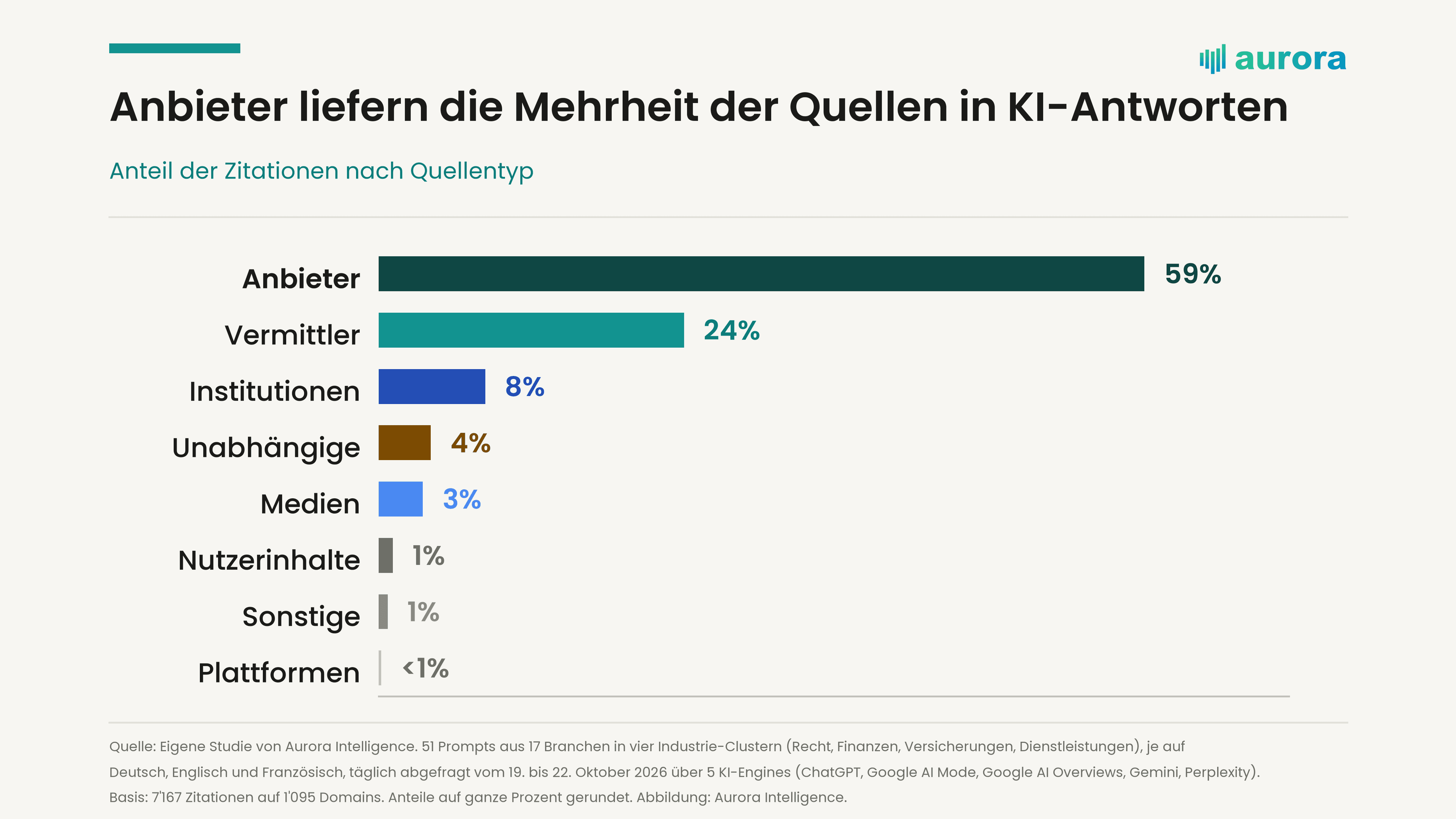
Providers account for almost 60% of all citations in Switzerland
The most common source of an AI answer is the providing company itself: 58.9% of all citations point to provider websites. Intermediaries follow with 23.5%, meaning comparison portals, directories and marketplaces. Institutions such as authorities, associations and universities reach 8.2%.
Three values are smaller than often assumed. Media reach 3.4%. User content such as review sites and forums comes to 1.1%, and social networks and video platforms together to 0.2%. Independent blogs, at 4.0%, are ahead of both. The much-cited Reddit is part of that 1.1% and barely affects visibility in our sample.
Individual websites carry very different weight
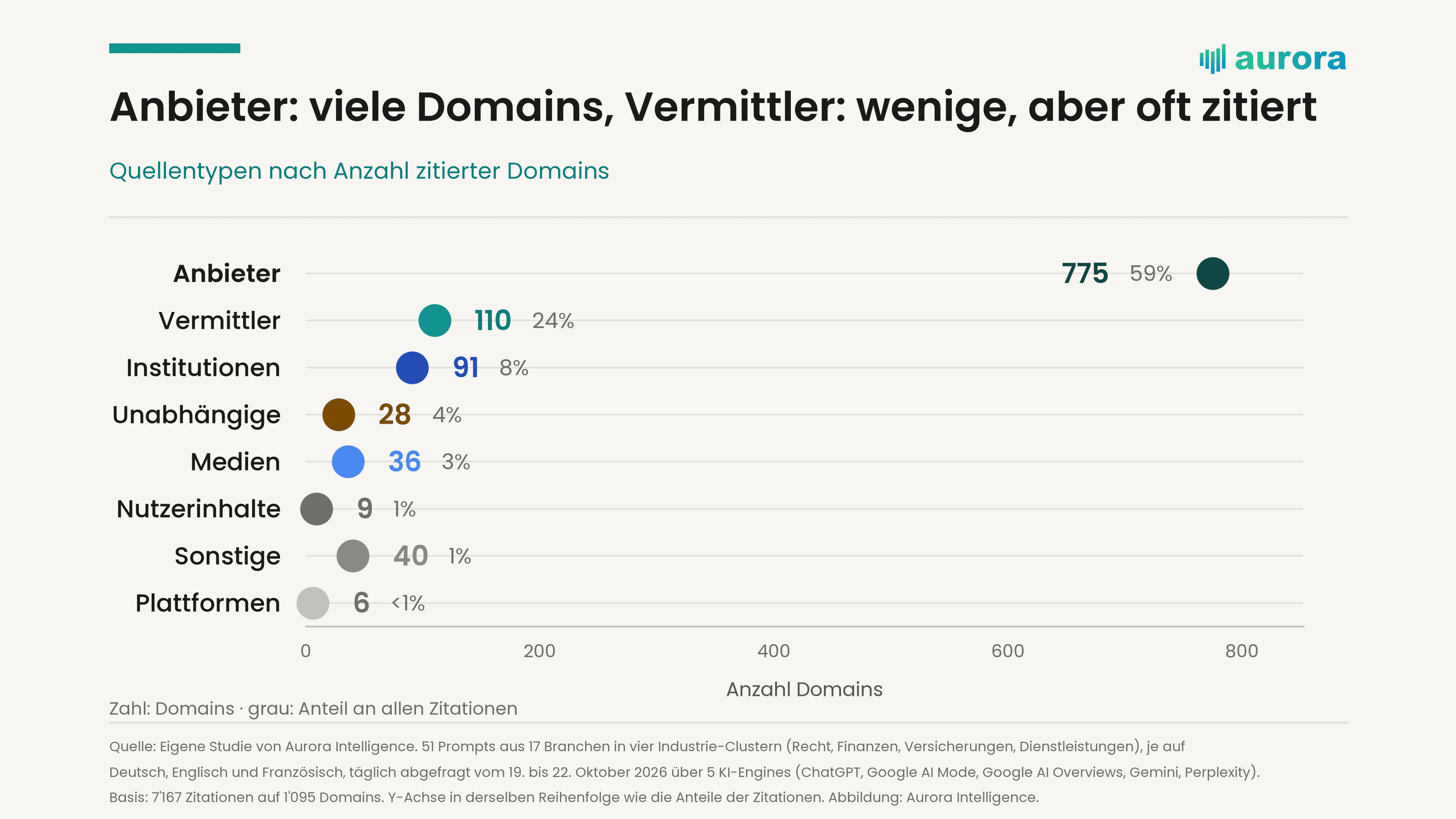
The share alone says little about how the field is structured. The providers' 58.9% are spread across 775 different websites. The intermediaries' 23.5%, by contrast, come from only 110 websites.
The arithmetic is simple: a single intermediary website weighs much more in the answers than a single provider website. Being listed correctly on one of the large comparison portals achieves more than adding another page to your own site. The chart below shows this.
Every AI system cites differently
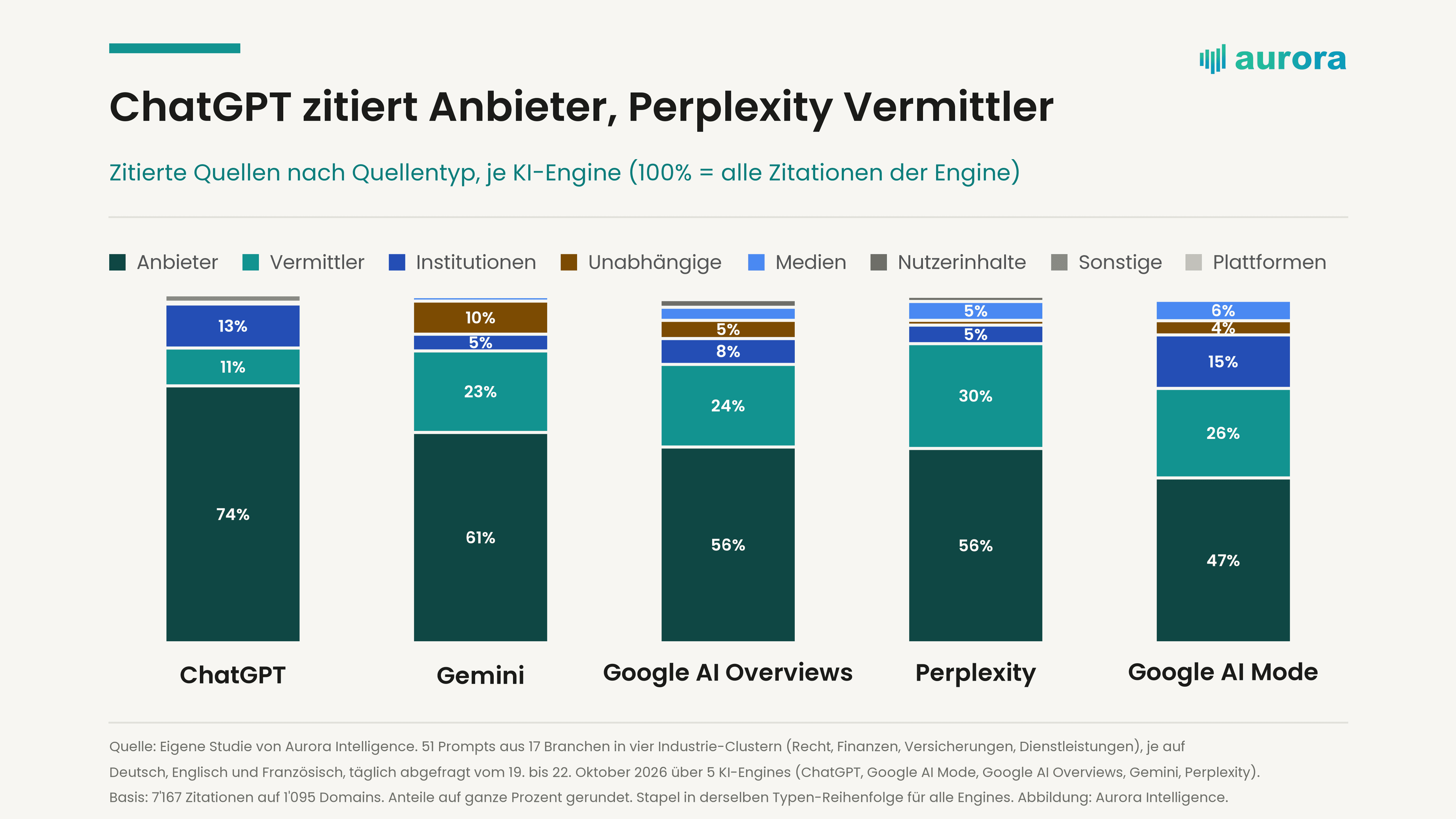
The five systems arrive at different sources even though they answer the same questions. Google's AI systems also differ from one another.
ChatGPT relies most on providers themselves: 74%. Google AI Mode sits at the other end with 47% and, at 15%, cites institutions most often. Perplexity uses intermediaries most (30%). Google AI Mode cites media most often (6%), just ahead of Perplexity (5%). Gemini turns to independent blogs much more often than the other systems, at 10%.
In practice this means that a visibility measurement covering only one system shows a distorted picture. For users of GEO or AEO tools it also means that an average across all systems often does not reflect where traffic actually comes from. In our previous article we showed that ChatGPT has by far the largest market share in Switzerland, which makes ChatGPT's sources the most important ones for GEO.
The sources of AI visibility differ by industry
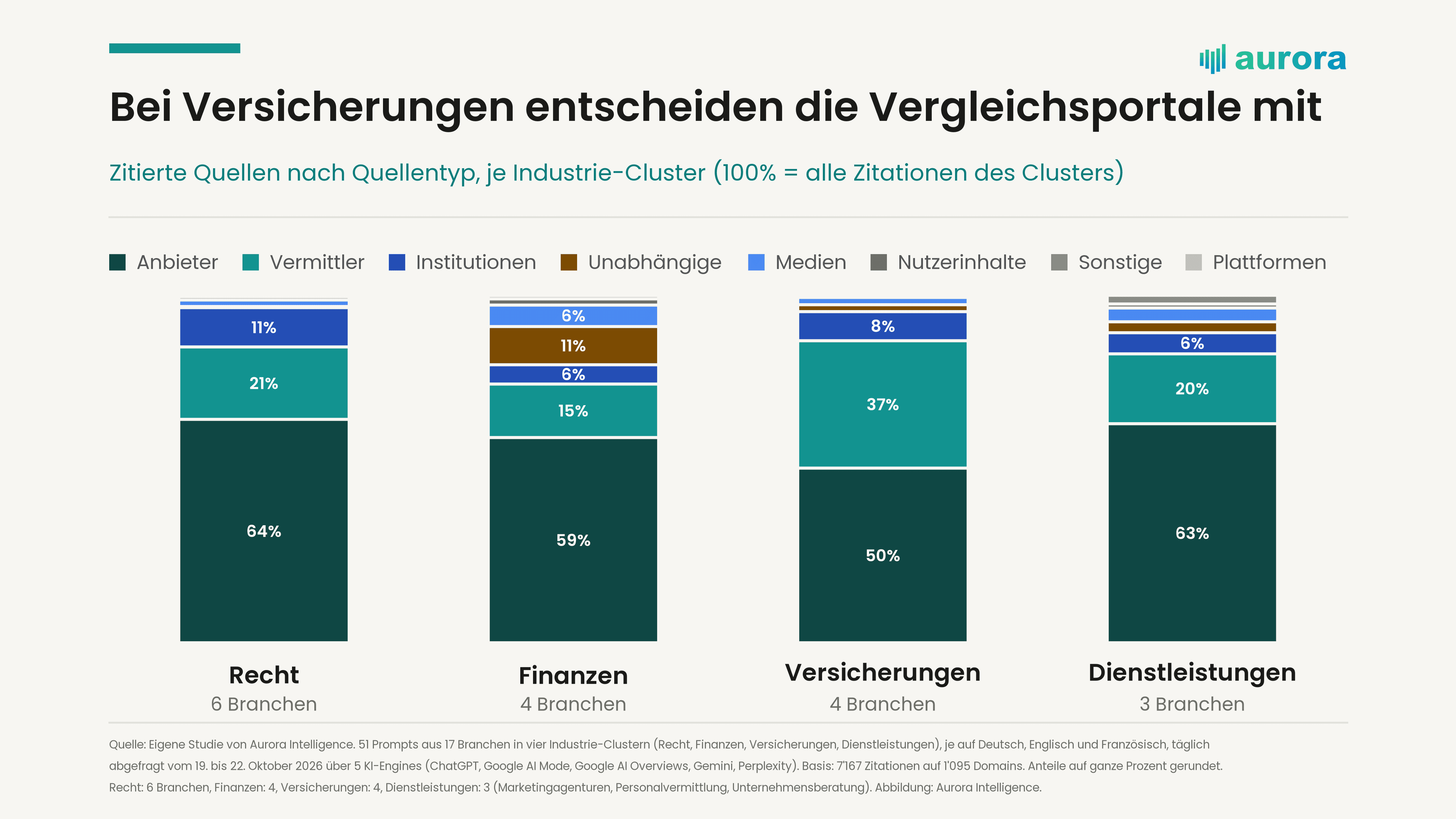
What holds for the AI systems also shows across Swiss industries. In insurance, 37% of sources are intermediaries; in legal services only 21%. Someone looking for insurance is therefore more likely to get an answer based on comparison portals than someone who needs a lawyer.
In finance a different value stands out: 11% of sources are independent blogs, more than twice as many as in any other cluster. For questions about pensions and investing, the systems cite private authors more often than institutions; here they appear to weight independence more highly.
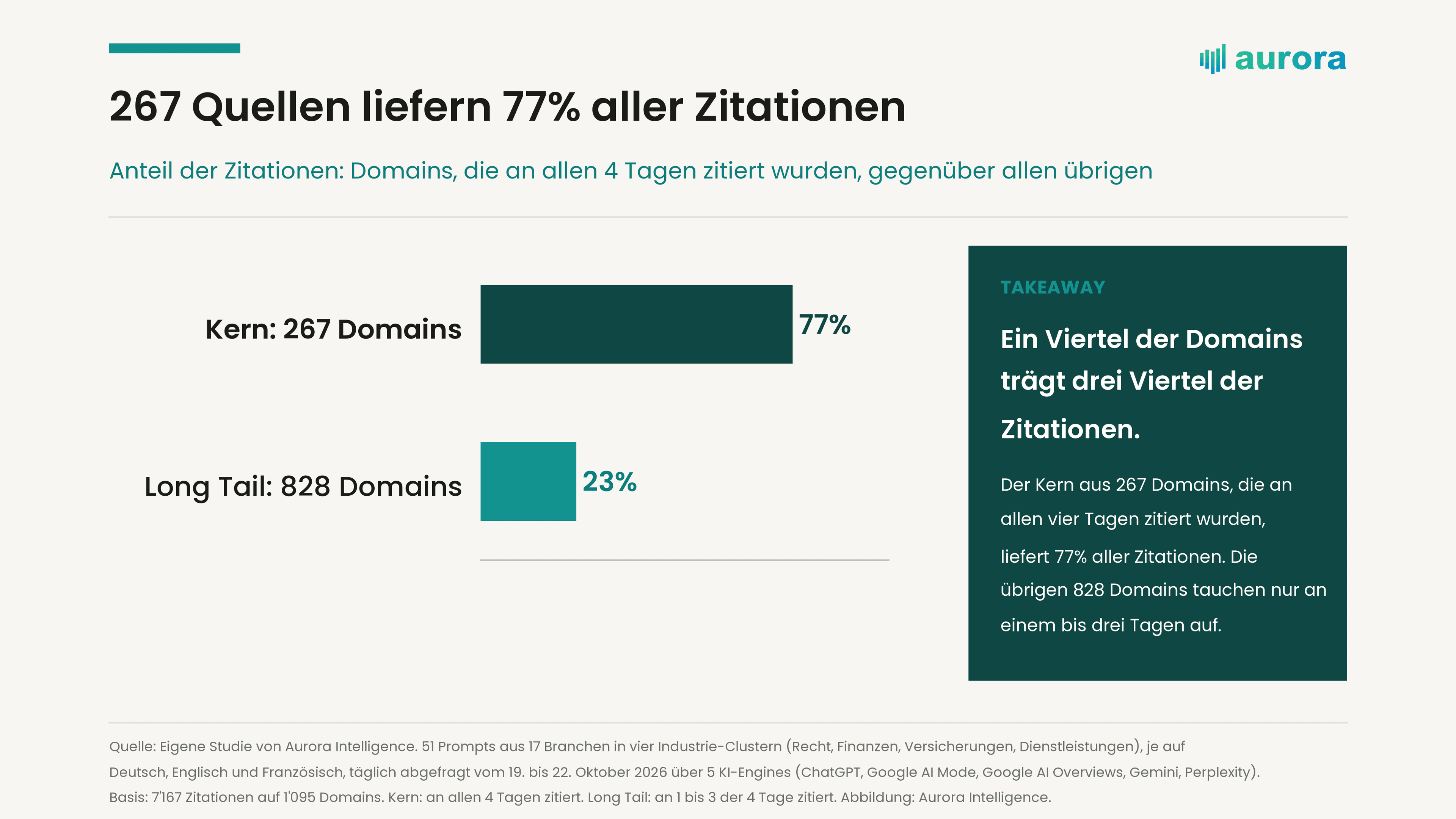
77% of citations come from 25% of websites
We measure daily. This shows how stable the cited sources are over time, and the answer is: only partly.
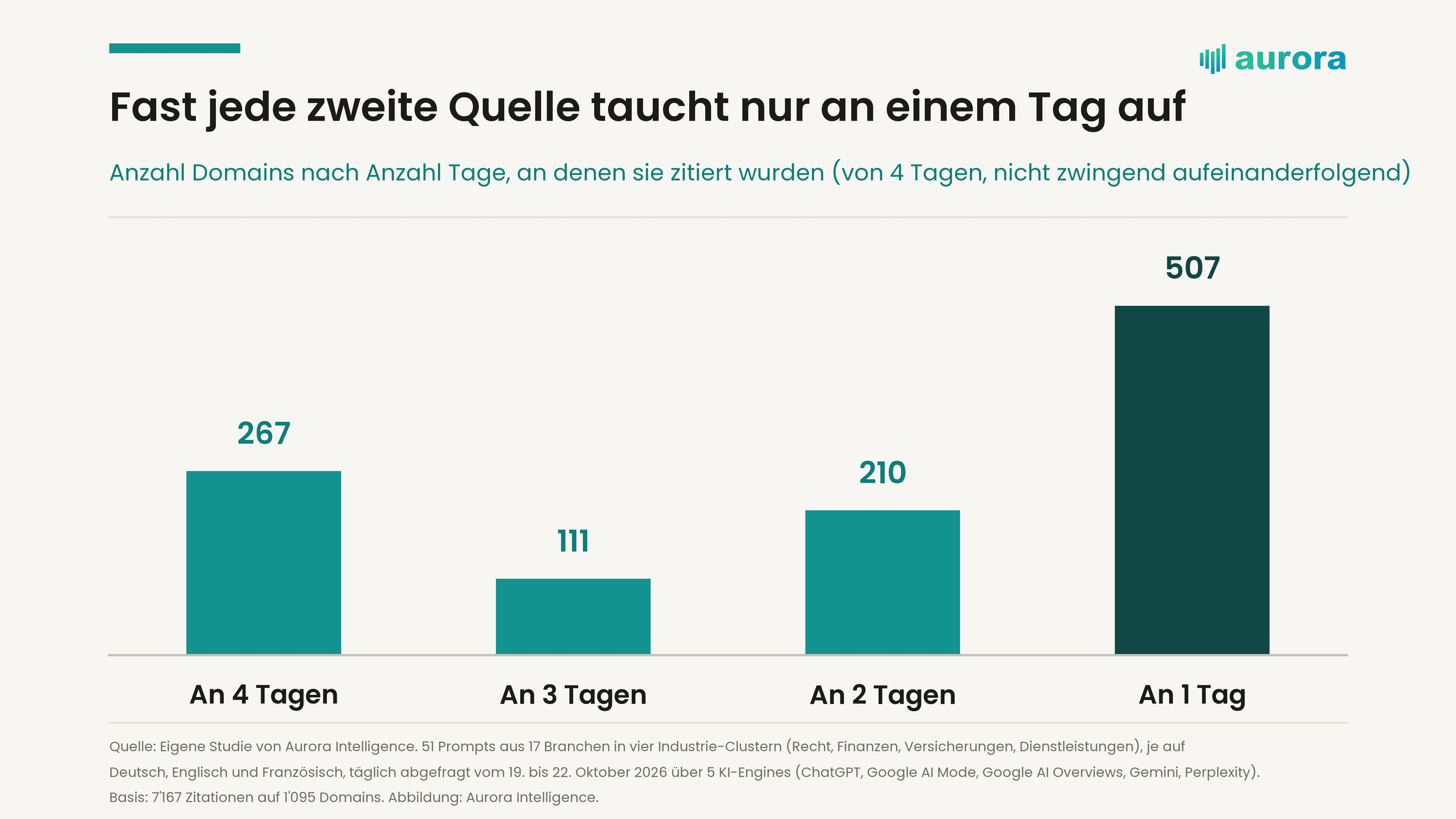
Of 1,095 websites cited over four days, 507 appeared on exactly one day, 210 on two days and 111 on three. Only 267 websites were cited on all four days. They carry 77% of all citations, which makes them the most valuable for GEO (also called LLMO or AEO). The rest is a much less valuable long tail.
A one-off measurement therefore largely captures sources that no longer appear the next day. Our recommendation to every marketer measuring with Aurora or another tool: spread your measurement across many data points and over time to identify the sources that matter most.
What does this mean for Swiss companies?
- Measure across all systems, and regularly. The provider share differs by 27 percentage points between ChatGPT (74%) and Google AI Mode (47%), and almost every second source appears on only one day.
- Your own website is the foundation, the portals are the lever. Providers make up almost 60% of sources, but spread across 775 websites. A single intermediary website therefore weighs more than one more page of your own.
- Work on the core, not the mass. 267 websites carry 77% of citations. This list can be determined for your industry and worked through.
The free visibility check shows whether and how your company appears in these answers.
Methodology
51 prompts from 17 industries in four clusters: legal (6 industries), finance (4), insurance (4) and services (3: marketing agencies, recruitment, management consulting), each in German, English and French. Queried daily from 19 to 22 October 2026 across five AI systems: ChatGPT, Google AI Mode, Google AI Overviews, Gemini and Perplexity. None of the prompts names a company; they ask what a customer would ask.
The analysis is based on four measurement days with 7,167 citations across 1,095 source domains. Each domain is assigned to a source type. Shares are rounded, so totals may differ from 100%. Four days are a snapshot, not a trend.
Sources
Own measurement by Aurora Intelligence, campaign "Schweizer Sichtbarkeit" (Swiss visibility), October 2026. Methodology and source classification available on request.